|
On a good day people in Haiti die from malnutrition, lack of clean water, and from easily treatable health problems. Now a major earthquake has killed tens of thousands outright and left both grand institutional structures and flimsy shantytowns destroyed. An infrastructure already failed prior to the natural calamity is leading to deadly delays in rescue and relief efforts. That’s why the ultimate death toll will be many times greater than similar past major quakes in California and Japan. The founding father of the Christian Majority, Rev. Pat Robertson, attributed Haiti’s suffering to their making a “pact with the Devil” two centuries ago. Other like-minded men of the cloth have objected to that unsubstantiated allegation, instead viewing Haiti’s people as simply unable to care for themselves, an example remaining of the Nineteenth Century concept of “white man’s burden.” In lock step with corporate dominated U.S. foreign policy, the charity industry, the missionaries and media ignore or suppress the true history of the Haitian people that led to their present plight. The former French West Indies colony of San Domingo saw the first successful revolt of African slaves that went on to take state power. They renamed their new nation Haiti. They were motivated not by Satanic promises but by the slogan of the French Revolution–Liberty, Equality, Brotherhood. For more than twelve years they battled white masters and military incursions by Spanish and British forces. After Napoleon Bonaparte reversed many of French Revolution’s gains he sent one of his top generals to restore rule in Haiti. The French and all the others were thoroughly whipped--not by the Devil but by self-liberated slaves. Their proud story was well documented by CLR James in The Black Jacobins. Over the next century the first Black-governed country in the Western Hemisphere maintained a sustainable agricultural society. Haiti’s long decline in to abject poverty did not begin until U.S. imperial expansion reached the area one hundred years ago. In 1910, the U.S. government, in partnership with the ancestral forerunner of CitiBank, cut a deal with the Haitian government to essentially buy out its entire financial system. They maintained direct control over every loan and investment in Haiti for the next 37 years. In 1915, Woodrow Wilson, who later won the Nobel Peace Prize, sent the Marines in to occupy Haiti to protect growing U.S. investments–and they stayed for nearly twenty years. When “civil unrest” started rising in the late Fifties the CIA installed the ruthless dictatorship of Papa Doc Duvalier, who was succeeded by his even more brutal son, Baby Doc, spanning nearly three decades. But even this gangster style rule was not as devastating as the neoliberal economics that largely destroyed Haiti’s sustainable agriculture in the Eighties. North American agribusiness giants started dumping cheap food in to the Haitian market. Haitian farms–especially their staple rice crop--collapsed and a mass exodus of peasants and farm workers in to Port-au-Prince began. Others who could immigrated to North America. The U.S. congressional passage of the HOPE Act in 2006, and HOPE II in 2008, opened up opportunities for American sweatshops, mainly in apparel. This production offshored from the USA accounts for two/thirds of Haiti’s meager exports but has provided relatively few jobs at even the standard HOPE wage rate of 28 cents per hour. Two/thirds of the Haitian workforce is outside the formal economy. One/quarter of the entire GDP is supplied by remittances sent back home from Haitians working in the U.S. and Canada. The Haitian government, essentially dependent on the USA and United Nations blue helmets to keep it in power, has done its best to pay the interest on Haiti’s enormous foreign debt and follow IMF guidelines for squeezing even more out of Haiti’s long suffering working people. If you want to incarnate Pat Robertson’s deal making Devil you can find him inside Washington’s Beltway. It is true that Haiti’s history and current status of relations with global capital has nothing to do with the tectonic shifts that started shaking the island Tuesday. But they determine how many will live and die in the coming days and weeks–and also impose an unacceptable definition of “recovery.” In the 2008 hurricane season four storms killed more than 800 in Haiti. In nearby Cuba, the same storms, inflicting great property damage, resulted in four deaths–and the government in Havana demanded detailed reports as to why these four were lost. It seems every life is precious to these “godless communists.” A substantial part of the woefully small number of physicians in Haiti were trained, at no cost to them, at the ELAM medical school in Cuba. Within a few hours of the first shock on Tuesday, Cuba was dispatching the first of a contingent of 400 Cuban doctors prepared to stay in Haiti as long as needed. This is no small effort for a country with a population about the size of Ohio, facing many serious material shortages of their own because of the U.S. embargo. The first efforts coming from the USA were waves of plane loads of television news staffs--along with their technical support numbering in the hundreds. They engaged in a morbid competition to exploit Haiti’s suffering in ratings wars that determine advertising revenue. In the process, of course, they required food, water, fuel, security, and parking space on the crowded airport tarmac. (Prior to the quake there was only one American correspondent based in Haiti.)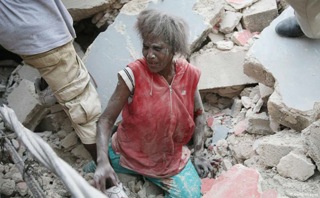 One scene missed by the major networks was the regularly scheduled docking of a 4300-berth cruise ship operated by Royal Caribbean at the harbor and resort they lease just sixty miles from Port-au-Prince. As usual, passengers were encouraged to jet-ski and party on the company’s exclusive private Labadee Beach. Passengers could securely eat, drink, and be merry in a compound enclosed by a twelve-foot high wall, closely monitored by armed guards. The official charity of Big Business and the military brass, the American Red Cross, immediately sprung in to action–providing a text message keyword to send them money via mobile phone. But our side also responded and we are proud of them. The RN Response Network of National Nurses United already had 700 nurse volunteers signed up to go to Haiti the morning following the quake. By the next day they announced, “With some 4,500 U.S. nurses signed up to volunteer for a Haiti disaster relief mission – and more than 1800 of them participating in a national conference call joined Thursday – National Nurses United (NNU) today announced it will set up a command center in Miami to prepare the first team for deployment. “The first team of nurses to go is expected to include NNU Co-president Deborah Burger, Haitian American RNs, and nurses who have worked in previous disaster relief programs following Hurricane Katrina and the South Asia tsunami organized by the NNU’s Registered Nurse Response Network.” By last report the number of volunteers now stands at about 10,000. For most of us the only practical concrete expression of emergency solidarity with Haiti is financial contribution. Early on I posted a link to Oxfam’s Haiti relief effort because they have a good reputation for honesty and competence and were already on the ground in Haiti. Since then Labor Notes published a list of labor-based efforts. Certainly the Nurses need and deserve support for their effort as well. We should all pitch in during this acute emergency. But let’s not forget the working people of Haiti when things return to the “normal” chronic disaster. We need to strengthen the solidarity ties between our countries and help get the North American bosses, bankers, and governments off their backs. reprinted from weekly column by Bill Onasch, KC Labor
|