|
February 19, 2015 - The Office of Inspector General (OIG) issued a report titled “Safety and Security-Opportunities Exist to Improve the Safe-2-Safer Program”.
Safe-2-Safer is the product of Behavioral Science Technology (BST), a consulting and management firm who provide a behavior-based safety program geared toward changing a company’s safety culture. Other Class 1 railroads in the United States do not use the BST product as safety programs.
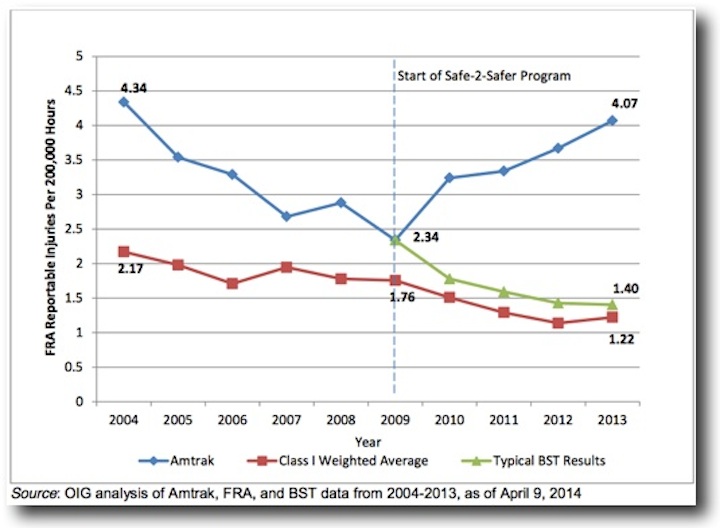
To compare employee safety at different railroads, the Federal Railroad administration (FRA) uses an injury ratio - the number of employee injuries per 200,000 hours worked. The OIG analyzed the injury ratio data that FRA collected and maintained over a 10-year period from 2004 to 2013.
 The OIG analysis showed that since the initiation of the Safe-2-Safer program on Amtrak in 2009, the average injury ratio for the other Class 1 railroads (freights) declined by 30%, but the Amtrak injury ratio increased by 74% from 2.34 to 4.07 in 2013. Amtrak’s FRA-reportable injury ratio was more than three times the average of the other Class 1 railroads in 2013. Reported injuries on Amtrak have risen for four straight years, and no major changes appear to have been made to the Safe-2-Safer program, other than an increased emphasis on employee observations. The OIG analysis showed that since the initiation of the Safe-2-Safer program on Amtrak in 2009, the average injury ratio for the other Class 1 railroads (freights) declined by 30%, but the Amtrak injury ratio increased by 74% from 2.34 to 4.07 in 2013. Amtrak’s FRA-reportable injury ratio was more than three times the average of the other Class 1 railroads in 2013. Reported injuries on Amtrak have risen for four straight years, and no major changes appear to have been made to the Safe-2-Safer program, other than an increased emphasis on employee observations.
The Brotherhood of Railway Signalmen (BRS) represents workers in Amtrak’s C+S department and has never participated in the Safe-2-Safer program. They did not agree to participate primarily because they considered the previous safety program, which they had negotiated in 2000, as sufficient and binding. BRS employees on Amtrak had an injury rate of about 2.2 for 2013, or roughly half of the rate of those Amtrak workers participating in Safe-2-Safer.
The OIG reports that the Safe-2-Safer program has cost Amtrak about $70.1 million through September 2014. The OIG also estimates that Safe-2-Safer costs will increase about another $24.1 million during FY 2015 and 2016 if Amtrak continues to operate the program in generally the same manner. Consulting fees paid to BST will exceed $30 million dollars in the same measurable period while training costs are $15.1 million dollars.
Amtrak’s safety culture is measured through the results of a Safe-2-Safer biennial survey that was administered three times - in 2009, 2011, and 2013. In 2013, almost 11,700 employees responded to the survey - a response rate of 58%. To provide a relative perspective on these scores, Safe-2-Safer compared Amtrak’s survey results with results from their other clients. Amtrak scored the lowest in organizational value for safety and management credibility - in the bottom quartile of Safe-2-Safer’s clients in these aspects of safety culture.
So where are we? Amtrak is hemorrhaging money on a failed safety program, injuries and deaths of workers have dramatically increased, and Amtrak management, the FRA and the OIG do nothing but issue reports and provide lip service. If you are enraged by this report, then perhaps it’s time to engage in the war against workers. It has become crystal clear that Amtrak workers are under attack and it’s not just our wages and benefits at stake but our lives and the livelihoods of our families. An injury to one is an injury to all.
View report here.
|