|
Remarks of General Chairman Jed Dodd Workers Memorial Day
April 29, 2016 - Philadelphia, PA
Brothers and Sisters,
As we gather here on Workers’ Memorial Day, I bring you greetings of solidarity and friendship from our Union, the Brotherhood of Maintenance of Way Employees a division of the Teamsters Union. I would like to recognize and thank our National Division President, and also a Teamsters International Vice President, Freddie Simpson for attending and showing support as our struggle for safe working conditions intensifies and sharpens on Amtrak. Workers’ Memorial Day is a day in which we remember and honor our friends, coworkers and loved ones who were prematurely taken from us while working to earn a living for themselves and their families. It is a day that we have set aside to recognize that, despite the best wishes of management, the best efforts of our members and the verbal support from the politicians and government regulators, too many of our members — of America’s work force — are killed and injured while working to support their families.
My name is Jed Dodd, and I am a regional head and a National officer of the Union. Our rail union constructs and maintains the track, bridges and buildings and overhead catenary systems on railroads in the United States. We represent foreman, laborers, welders, repairmen, heavy equipment operators, construction crafts and electricians. Our 40,000 members are highly skilled and our work is hard and dangerous. It is our people who clear the track and the right of way during blizzards and reconstruct the track structure during floods and other horrific storms. We work night and day in the bitter cold of winter, and the teaming heat of summer, in order to make certain that our nation’s products reach their markets and America’s commuters and passengers reach their destinations safely and on time. We are proud to provide this critical and valuable resource to our Nation.
In the last 18 months we have had four union members struck and killed by passenger trains on Amtrak’s Northeast Corridor. Sister Minwella Kline, a signal maintainer helper was killed on the Albany line on October 29, 2014. Last month, on March 1, Brother Dawud Bahr a trackman was struck and killed by a passenger train in New Brunswick, NJ. On April 3, 2016, a train slammed into a backhoe working on the mainline in Chester, PA killing Brother Joe Carter, an equipment operator and Brother Pete Adamovich his supervisor, also a Union member. I would also like to acknowledge Janet Sparks, who is here with us today and whose son, Kevin Sparks, was a member of our Union and killed on SEPTA on November 11, 2009, when while working as a track inspector he was struck and killed by a passenger train. We are all to familiar with the pain and agony of having our friends and co-workers taken from us.
Demanding a safe work environment should be the central mission of any trade union. Safety is union business and the very core of our struggle for worker’s rights. It is more critical in our industry than in most.
According to government statistics, Maintenance of Way work is the third most dangerous job in America. Our jobs are more dangerous than that of police officers and firefighters. Underground mining is the only industry that has a higher injury and fatality rate than ours.
The names of our recently passed Sister and three Brothers will be carved onto a memorial wall in Union Station along with the other 73 railroad workers who have died on the job since Amtrak was created in 1976. While the engineering crafts represent only 10 per cent of the total workers at Amtrak, over one-third of the names on that wall are members of the engineering unions. Of the 27 members killed on the job, 21 members were struck and killed by passenger trains. All of them were taken from us needlessly. I knew many of these men personally. I considered some of them my friends. Unfortunately, the list of our dead is so long that every railroad worker can personally relate to this wall. Their deaths are senseless and cannot be given meaning. The horror of the sheer randomness of their deaths makes us all afraid. Those of us who work on the railroad know that it is a mere act of chance that permits us to stand and honor these names rather than to have our own names thus honored.
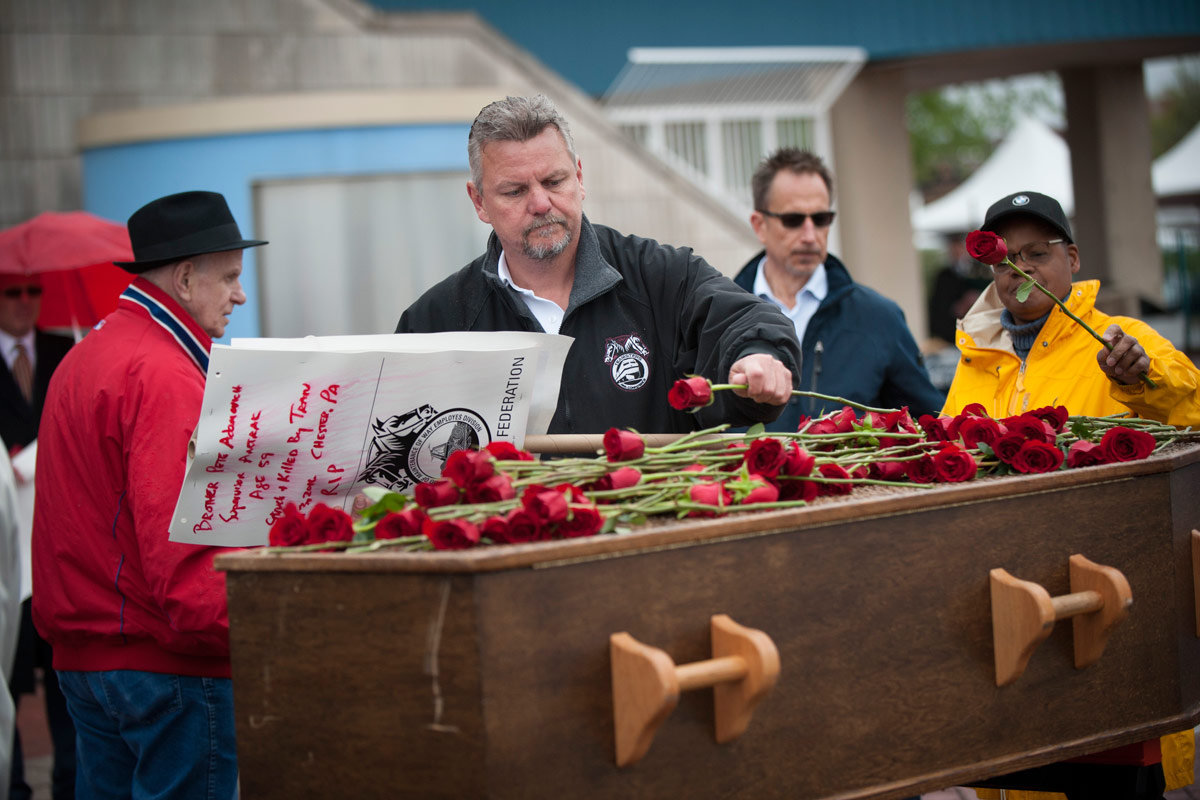 This monument to our dead represents our greatest collective failure. We all feel the rage and the anger; the fear and the impotence; the shame and the regret; the guilt and the sadness which is represented on this wall. However, there is no amount of angry rhetoric that can do justice to the men and women whose names we honor today. The time for self-loathing and hate must be left behind. We must not succumb to the draining emotional conflict of despair. To give this monument meaning, and thus give honor to our deceased friends and coworkers, we must resolve today, here and now, that without regard to the cost of the effort, to guilt or innocence, or to ego or preconception, that we will never again add another name to this wall. With this pledge, we hope that the deaths of our friends, coworkers, and loved ones can be honored in a meaningful way. This monument to our dead represents our greatest collective failure. We all feel the rage and the anger; the fear and the impotence; the shame and the regret; the guilt and the sadness which is represented on this wall. However, there is no amount of angry rhetoric that can do justice to the men and women whose names we honor today. The time for self-loathing and hate must be left behind. We must not succumb to the draining emotional conflict of despair. To give this monument meaning, and thus give honor to our deceased friends and coworkers, we must resolve today, here and now, that without regard to the cost of the effort, to guilt or innocence, or to ego or preconception, that we will never again add another name to this wall. With this pledge, we hope that the deaths of our friends, coworkers, and loved ones can be honored in a meaningful way.
Hopefully, this will provide a small comfort to their families who must continue to live with their loss every day.
The recent increase in fatalities on Amtrak is relatively new and comes with the change in management when career politician Joe Boardman became the CEO. In the twenty year period from 1976 to 1996 there were 14 members of the Union struck and killed by trains on Amtrak’s Northeast Corridor. During this period there were no Federal regulations regarding working on the tracks and while some of the individual railroad companies had some safety rules governing working on the tracks there was no legitimate way to enforce them without risking disciplinary action. We mobilized our membership to demand safe working conditions. We petitioned Amtrak, Conrail and the Federal Railroad Administration for agreements, and rules, to protect workers when we are working on the right away. Many of us risked arrest and jail as our tactics escalated into civil disobedience to stop the slaughter. Finally, in the winter and early spring of 1994, following the death of two of our members, and the mutilation of a third on Conrail, we rose up and struck this railroad shutting down hundreds of trains in 17 states. That evening a Federal judge ordered us back to work, but not without first putting Conrail’s safety rules under the jurisdiction of the Federal court. The week following the strike the Federal Railroad Administration announced the first Roadway Worker Protection rule making to protect railroad workers. Out of this struggle emerged 50 new regulations, the most important being Roadway Worker Protection regulation 214.329 which states:
“Roadway workers must be provided train approach warning in time sufficient to secure all equipment and be in the clear a minimum of 15 seconds prior to the arrival of a train at the point where walking, working or fouling. They must be clear of all tracks, or clear into working limits established for on-track safety.”
Our victory was in wining the 15 second rule. For a period of time this rule was relatively successful. Following the enactment of the regulation, in the 16 year period from 1997 to 2013, there were 3 union members struck and killed by moving trains on Amtrak’s Northeast Corridor. While it goes without saying, we find no death or injury to a worker acceptable, we were moving in the right direction with this substantial reduction in the rate of death.
So, what happened when Amtrak President Joe Boardman assumed the helm of Amtrak and gave us four employee fatalities in the last 18 months. Joe Boardman withdrew the cooperation of Amtrak from our jointly negotiated safety program that was hugely successful in reducing lost time injuries. He instituted a management controlled, behavioral based snitch program brought to us by his safety consultants with whom he had a relationship when he was head of the Federal Railroad Administration. Under his program, injuries have more than doubled and he spent 80 million dollars of the tax payers money for this result. He eliminated all of experienced senior managers who had any railroad operational or maintenance experience and replaced them with bureaucrats and politicians. He fired middle level managers without due process which has made those who remain afraid to speak up. He cancelled a close call policy that permitted labor and management to investigate and fix close calls before they became fatalities. He instituted a draconian discipline policy that fires anyone who violates the rules, or knows of someone who violates the rules. This results in no close calls being reported so they can be investigated before they become a fatality. Finally, he has corporatized the training department. The training used to be relevant and was taught by veteran railroad employees. Now it is taught by management trainers who have no railroad experience. Moreover, when coupled with a current workforce where the majority of whom have less than five years of service, conditions exist that foretell disasters and tragedy waiting to happen.
NORAC is the name of the operating rules of the railroad that govern the movement of trains and track equipment on the right of way. There are 998 rules written on 142 pages and they are taught in a three day course by instructors who have had no practical application of these rules. There are 52 Roadway Worker Protection rules and they are also taught by instructors who have no practical application in the use of these rules. We are trained and qualified by these unqualified instructors and then booted out onto the railroad to work for a management team who doesn’t have any practical railroad operational or maintenance experience, or if they do they have been terrified into silence.
This is happening to all of our jobs, not just railroad jobs. Corporate America is corporatizing they're training and safety departments to minimally comply with regulatory requirements, but with the primary purpose of cutting costs and maximizing profits. Properly training and qualifying employees costs money. We now have regulations to keep us safe and some ability to enforce them on the job, but without the training, experience and cooperation at the job site level our jobs are as dangerous today as they were before our initial struggles in the 80s and 90s.
We have written to Amtrak management demanding justice and presented them with a list of crucial reforms. The reasons for the slaughter may have changed since our initial struggle in the 1980s and 90s; however, the arrogant and cost cutting management is the same. This management hides behind a facade of civility with their MBAs and legal degrees, but the mantra is the same. Once again we are being challenged to take the steps necessary to protect our friends and co-workers from further needless deaths. While our demands are different to address these new challenges, our tactics are still the old school power found when we act as a united force. This Union will use any means necessary to protect our members from this new management and their schemes. We will fight like our lives depend upon it because they literally do.
Let me ask you, are there any railroad workers in the house?
Let me hear your say Union!
Are you willing to make the necessary sacrifice to ensure that members of our Union return home to their families alive each day?
Let me hear you say Union!
Stand up if you think it is time to strike Amtrak and shut down the Northeast Corridor to force Amtrak to provide a safe work place and to protect our lives!
Let me hear you say Union!
Are we ready to risk arrest and go to jail to ensure that every member of our Union can return home safely to their family?
Let me hear you say Union!
When the union's inspiration through the workers' blood shall run. There can be no power greater anywhere beneath the sun. Yet what force on earth is weaker than the feeble strength of one.
Sticking together our power is second to none.
By any means necessary.
Thank you Brothers and Sisters.
Power to the People!
|