| |
|
The American Labor Movement proclaimed its intention to come back together this week Some of you may have seen the column by Harold Meyerson regarding unification discussions that are taking place between the AFL-CIO, Change to Win and the NEA. The column contains information that is inaccurate and misleading. For your information, attached is a response by AFL-CIO President John Sweeney which clarifies the position of the AFL-CIO. Click here for President Sweeney's response. Mr. Meyerson's column can be viewed here.
|
|
|
| |
|
February 18, 2009 WASHINGTON - New Amtrak President Joseph Boardman says many Amtrak managers do not know whether to believe that Amtrak actually has a future, and that anyone who cannot make the transition from a survival mode to a growth mode will have to find another job. Boardman said in an interview that shortly after leaving the top spot at the Federal Railroad Administration last Thanksgiving to take over Amtrak, he discovered that the passenger rail system is in worse shape than he thought, and that some people in Amtrak headquarters in Washington are, in effect, burnout cases. He would not be specific about numbers, saying he has still made no final decisions about how many people will have to leave because they cannot make the transition from survival to growth. Read More...
|
|
|
| |
|
A top labor adviser to President Barack Obama and a central negotiator in union merger talks hinted late last week that it was unlikely that Change to Win and the AFL-CIO will finalize a deal by the target date of April 15.
"We've been having regular meetings and we're going to continue to do that. ... We hope to have something to show in the next couple of months," former White House transition adviser and ex-House Democratic Whip David Bonior (Mich.) said, declining to reconfirm the April 15 deadline. "Is it going to be all wrapped up by then? I can't tell you that at this point." Read More...
|
|
|
| |
|
Railroads made Chicago, and now a Chicago-rich White House wants to return the favor: remaking rail with a huge new federal investment in high-speed passenger trains.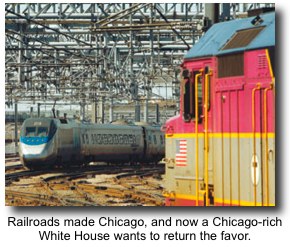 The $787.2 billion economic recovery bill — to be signed by President Barack Obama on Tuesday — dedicates $8 billion to high-speed rail, most of which was added in the final closed-door bargaining at the instigation of White House chief of staff Rahm Emanuel. It’s a sum that far surpasses anything before attempted in the United States — and more is coming. Administration officials told Politico that when Obama outlines his 2010 budget next week, it will ask for $1 billion more for high-speed rail in each of the next five years. Read More...
|
|
|
| |
|
Amtrak Put On Notice January 20, 2009 Amtrak failed to include time claim and grievance payments when calculating our back-pay. They do not consider claim settlements as subject to retroactive calculations. Obviously we disagree. January 20, 2009 Amtrak failed to include time claim and grievance payments when calculating our back-pay. They do not consider claim settlements as subject to retroactive calculations. Obviously we disagree.
Can You Say Self-Help? Alex Kummant knew Amtrak would attempt something like this. That’s why he was fired. In testimony before a Senate Subcommittee on Appropriations, Amtrak Alex had this to say about our recent agreement: "Let me conclude by saying we are going to have some big opportunities ahead, and we will need a strong, skilled and well-trained workforce with high morale if we’re going to make the most of them. To that end, these new labor agreements will help. I appreciate all of the hard work our employees put in every day, sometimes in difficult or trying situations, and I am glad that we have been able to conclude a workable settlement and trust that our employees will embrace it." |
Difficult to embrace a settlement when Amtrak continues to deal in bad faith.
Following is the text of General Chairman Dodd's letter to Amtrak's VP Bress.
overnight mail
January 20, 2009
Mr. Joseph M. Bress, Vice President – Labor Relations
National Railroad Passenger Corporation
60 Massachusetts Avenue, N.E.
Washington, D.C. 20002
Re: Calculation of Article I, Section 9 retroactive pay
Dear Mr. Bress:
Article I, Section 9 of the January 18, 2008 BMWED/Amtrak agreement provides for the payment of retroactive compensation to employees with an employment relationship with the Carrier as of December 1, 2007. These retroactive payments are to be made in two installments: 40% of the amount within sixty (60) days of ratification of the agreement and the remainder on or before the first anniversary of the initial payment. The Union recently was informed that Amtrak does not consider payments of claims and grievances that were settled or arbitrated with a remedy expressed in hours paid at a specific rate of pay; i.e., “eight (8) hours’ pay at the applicable Track Foreman rate”, to be part of the compensation received by employees that is subject to retroactive calculation. The Union strongly disagrees with this position and considers the Carrier’s position a repudiation of the January 18, 2008 BMWED/Amtrak agreement.
First, Article I makes retroactive adjustments to “all rates of pay” initially set by inclusion of the $.27 per hour COLA into the rates on July 1, 2002. Article I makes no exclusions for any “rates of pay,” including those utilized in the resolution of claims and grievances. Second, the Carrier distributed a four-page leaflet entitled “Frequently Asked Questions Regarding the Retroactive Payments” when the initial retroactive payments were made under Article I, Section 9. These “FAQs” noted that the adjustments in hourly rates “applied to all hours paid during each period” when a rate was adjusted by a particular percentage increase. The “FAQs” continues by noting that payments already received during each period were subtracted from the new adjustment, as well as retroactive health and welfare cost-sharing amounts. That simple set of calculations, in the Carrier’s words, provided the “gross” retroactive compensation owed to each employee. The “FAQs” clearly states that “hours paid for or worked” are included in the retroactive compensation calculations. Accordingly, the Union does not understand now how the Carrier can allege that claim and grievance settlement and payments expressed in hours paid for are not considered part of the gross retroactive compensation amount owed to each employee.
Without prejudice to the foregoing, the Union also believes the Carrier’s actions implicate the “countdown” to self-help set forth in Article VI of the January 18, 2008 agreement. As you know, the bifurcated payment of retroactive compensation to the employees required the negotiation of what is Article VI of the January 18, 2008 agreement. Article VI reserved to the Union the right to exercise self-help if the Carrier informs it that it will not be able to make the full retroactive compensation payments required under Article I, Section 9. In this case, the Carrier’s failure to make retroactive adjustments to claims sustained on the basis of “hours paid for” is accepted by the Union as constructive notice that the Carrier will not make the full retroactive compensation payments required under Article I, Section 9. As such, the Union expects the Carrier to comply with its obligations under Article VI.
Please contact me as soon as possible to discuss this very serious issue.
Yours truly,
Jed Dodd
General Chairman
cc: Fred Simpson, President BMWED-IBT National Division
Don Griffin, BMWED-IBT Director of Strategic Planning
Pennsylvania Federation BMWED-IBT Joint Protective Board
All Amtrak General Chairman
All Pennsylvania Federation Committees |
printable format of General Chairman Dodd's letter to Amtrak's VP Joe Bress view the 2008 Wage and Rule Agreement, which includes Article 1, Section 9 Retroactive Payments and Article VI, Contingencies and Deferral of Self-Help copy of the referenced 4-page FAQ regarding Retroactive Payments
|
|
|
| |
|
Our nation is on the eve of one the most important moments in our history: the inauguration of the first Black president of the U.S. There is great excitement and hope, here and around the world.
 At the same time, the wars and occupations in Iraq and Afghanistan drag on: the death tolls mount and the financial costs are staggering, draining resources from our cash strapped communities and contributing to the current economic crisis. The “war on terror” has other costs, too, as our rights - especially the rights of the most vulnerable - have been systematically undermined. At the same time, the wars and occupations in Iraq and Afghanistan drag on: the death tolls mount and the financial costs are staggering, draining resources from our cash strapped communities and contributing to the current economic crisis. The “war on terror” has other costs, too, as our rights - especially the rights of the most vulnerable - have been systematically undermined.
We have been here before. More than forty years ago, a senseless war raged in Vietnam. The result: 58,000 young Americans and more than three million Vietnamese dead; a society broken and scarred; illegal assaults on our civil liberties, all in the name of patriotism. Today we are in the midst of an endless “war on terrorism” that has included invasions and occupations, and sweeping erosions in everyone’s basic human rights, particularly in communities of color.
In April 1967, Dr. Martin Luther King, Jr. spoke at New York’s Riverside Church about what Vietnam meant for the United States. His words remind us of the choices we face in 2009, and how urgent it is that we change current U.S. policies—in Iraq, in the Middle East, around the world, and here at home.
“I knew that America would never invest the necessary funds or energies in rehabilitation of its poor so long as Vietnam continued to draw men and skills and money like some demonic, destructive suction tube. So I was increasingly compelled to see the war as an enemy of the poor and to attack it as such.
“It became clear to me that the war was doing far more than devastating the hopes of the poor at home. It was sending their sons and their brothers and their husbands to fight and die in extraordinarily high proportions relative to the rest of the population. We were taking the young black men who had been crippled in our society and sending them 8000 miles away to guarantee liberties in Southeast Asia which they had not found in Southwest Georgia and East Harlem.
“I knew I could never again raise my voice against the violence of the oppressed in the ghettos without having first spoken clearly to the greatest purveyor of violence in the world today—my own government.
“The war in Vietnam is but a symptom of a far deeper malady within the American spirit, and if we ignore this sobering reality we will find ourselves ... marching and attending rallies without end unless there is a significant and profound change in American life and policy....
“[W]e as a nation must undergo a radical revolution of values. When machines and computers, profit and property rights are considered more important than people, the giant triplets of racism, materialism, and militarism are incapable of being conquered.
“A true revolution of values will soon cause us to question the fairness and justice of many of our past and present policies.... A nation that continues year after year to spend more money on military defense than on programs of social uplift is approaching spiritual death.”
Forty-two years later, Dr. King’s challenge to us remains. Our country can make a change, a turn towards humanity and law and decency. Or we can continue down the road of deepening social injustice and permanent war. It’s time for our government to turn to the values of Dr. Martin Luther King, Jr. — take action to make that change. This message shared by permission from our friends at United For Peace And Justice
|
|
|
| |
|
January 7, 2008 The nation’s largest labor unions called Wednesday for reuniting the American labor movement, which split apart three and a half years ago when seven unions left the A.F.L.-C.I.O. and formed a rival federation, Change to Win.The 12 union presidents issued a statement, saying: “The goal of the meeting is to create a unified labor movement that can speak and act nationally on the critical issues facing working Americans. While we represent the largest labor unions, we recognize that unity requires broad participation.”
The call for reunification was something of an about-face for the presidents of the Service Employees International Union, the Teamsters and several other unions that quit the A.F.L.-C.I.O., asserting that the federation was stodgy and had not done enough to reverse organized labor’s long decline. The breakaway unions formed a federation called Change to Win. ...read more
|
|
|
| |
|
December 19, 2008 James "Brokenrail" Brunkenhoefer, age 61, died after suffering a stroke two days earlier. He also was a member of the UTU and United Transportation Union Insurance Association (UTUIA) boards of directors. Affectionately known as "Brokenrail," he was serving his fifth term as the UTU's chief lobbyist and was one of the mostly widely recognized individuals on Capitol Hill...read more
|
|
|
| |
|
December 18, 2008 Amtrak Issues a Special Employee Advisory entitled "A Message from President and CEO Joe Boardman”. He writes: "At a meeting with labor leaders last month, I said that it was my intent to deliver the retroactive pay in 2009.” Are you kidding? Could you be more condescending, Mr. Boardman? We have no doubt the remaining 60% of back pay obligations will be paid in 2009. Please refer to the January 18, 2008 Wage and Rule Agreement, Self-Help, Article VI, page 14. Is it any wonder Rail Labor openly protested his appointment?
The Advisory continues "We have an incredibly dedicated workforce. It’s important to me that you know that I value the work you do, and that I will go to Congress for you." Lets see if Mr. Boardman holds these same feelings when we begin to negotiate our next Amtrak contract. We know firsthand the value Amtrak places on our labor. View the Special Employee Advisory in printable format
|
|
|
|